

Dubai has officially transformed into the main central nervous system for trans regional trade across the globe. As a business owner or a supply chain manager looking at regional fulfillment costs, you already know that managing inventory in this fast-moving environment is a massive operational challenge. The industrial real estate market is changing quickly and third-party logistics pricing structures are fluctuating all the time. Pinning down the exact warehouse cost in Dubai per pallet requires looking far beyond a single flat generalized number. Many commercial shippers expect a basic fixed rate when they start searching for space. However as prime logistics rents continue to climb standard historical quotes are rapidly changing. To protect your firm’s profit margin, you must evaluate geographic micro markets specialized climate control systems physical layout expenses and complete fulfillment processing fees. This comprehensive guide breaks down the true cost components of industrial storage across the region.
The market is moving away from flat quotes toward precise volumetric billing
Many traditional warehouse operators used to provide a simple flat monthly rate for every single wooden pallet brought to their receiving docks. That old way of doing business is disappearing because local industrial real estate has become incredibly valuable. Average prime rents across the core industrial corridors have escalated to a range between AED 40 to AED 65 per square foot annually. Because of this massive surge top tier facility managers cannot afford to leave any vertical space empty.
Flat monthly quotes can easily camouflage hidden physical restrictions on your actual stack heights. If your products are heavy or irregularly shaped and cannot be stacked safely you are occupying valuable floor space without maximizing the height of the room. To build trust and protect their revenue modern warehouse operators now utilize CBM metrics to bill their clients accurately based on actual occupied cubic volume. This volumetric density model ensures that you pay only for the exact space your cargo physically occupies in the air.
Geographic micro markets create major opportunities for smart supply chain arbitrage
The industrial zones across the emirate are highly segmented and feature completely different baseline cost structures. Choosing where to position your inventory depends entirely on your target delivery speeds and your product characteristics. The Jebel Ali Free Zone offers the lowest baseline space costs for companies looking for long term bulk storage options. Shippers can find non-air-conditioned space in this zone for around 3.96 AED per square foot. This cost-effective location is perfect for industrial materials or raw components that can handle the regional climate without any thermal degradation.
Conversely urban clusters like the Al Quoz Industrial Area charge a major premium from the market. Climate controlled space in Al Quoz can easily cost 9.80 AED per square foot. While this rate is significantly higher, it dramatically compresses your last mile delivery times to consumers living in the center of the city. Smart supply chain directors practice geographic arbitrage by keeping their slow- moving bulk inventory in cheaper outer zones while positioning their fast-moving stock in premium urban fulfillment centers.
High density racking configurations maximize spatial yield to lower your storage costs
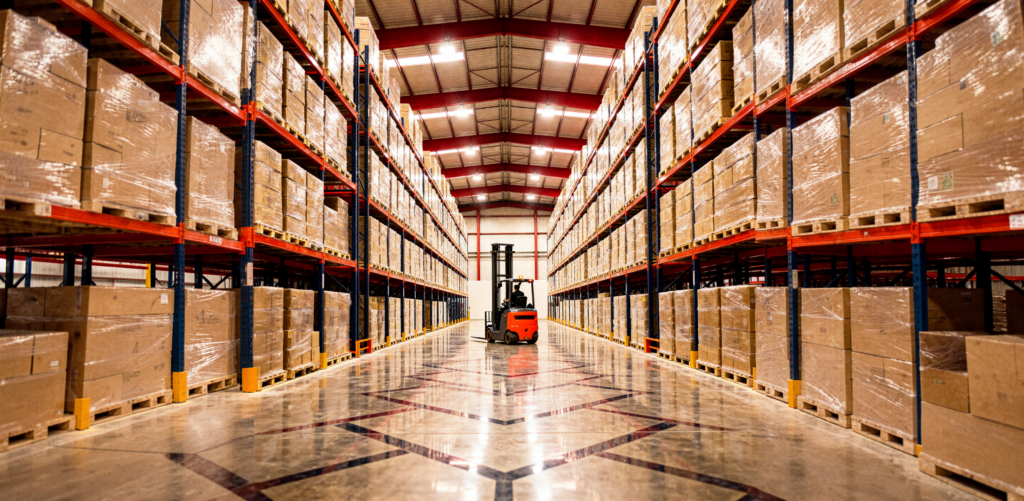
To counteract the soaring costs of land leases, modern logistics facilities are changing their indoor engineering plans. Traditional selective racking systems remain highly popular because they offer total direct access to every single pallet position. However, this open layout requires a massive amount of wide aisle space so forklifts can turn around safely.
To maximize their volumetric yield warehouses are trading away complete individual accessibility for high density deep lane architecture. These advanced systems include Drive In setups and Push Back tracks and Double Deep racking systems. A Double Deep racking configuration allows the operator to store two pallets behind one another on the shelf. This smart adjustment eliminates half of the traditional access aisles and packs significantly more cargo into the exact same square foot footprint. For businesses moving uniform bulk inventory these compressed systems offer a massive advantage by lowering the total spatial overhead per product unit.
Calculating the exact monthly costs of an individual pallet footprint
Let us look at the precise physical math that determines your actual monthly storage invoice. A globally recognized European standard pallet measures exactly 1.2 meters by 0.8 meters. When your warehouse team loads your goods onto this platform to a precise height of 1.0 meter the total size equates exactly to 0.96 Cubic Meters.
If you are storing your goods in a standard ambient warehouse that charges an average market rate of 85 AED per Cubic Meter, this single pallet position will cost you 81.60 AED per month before value added tax. If your products are sensitive and require temperature-controlled storage, the market rate typically rises to around 120 AED per Cubic Meter. This climate control upgrade drives the storage cost for that exact same pallet to 115.20 AED monthly. Recent institutional indices highlight that warehousing costs across core logistics corridors have experienced sharp jumps of up to 40.8% within a single quarter. Understanding these exact volumetric conversions is critical for creating an accurate corporate logistics budget.
Outfitting a self-managed facility involves heavy capital expenditures and long-term risks
Many expanding retail brands believe that leasing an empty industrial building and managing it themselves is the best way to save money. This strategy can easily become a dangerous financial trap because building out a modern facility requires an incredible amount of upfront money.
Purchasing standard selective racking systems will cost between 1500 AED and 2500 AED per position for regular duty loads. On top of that heavy equipment cost you must allocate an additional 150 AED to 300 AED per position for professional installation labor cost. You also have to navigate through local municipal regulations and secure mandatory approvals. A forklift collision can cause a catastrophic structure collapse if your equipment is not installed perfectly. Managing your own facility turns a flexible storage need into a massive fixed operational liability that can drain your working capital very quickly.
Inbound processing and fulfillment fees represent costs that happen beyond the rack
True unit economics require you to look far past the simple cost of renting a physical shelf. You must calculate all the operational fulfillment fees associated with moving your goods in and out of the building. Warehouses apply specific inbound processing fees to cover the daily labor cost of unloading trucks and checking inventory barcodes.
If you run a modern e-commerce brand you also need to factor in mixed SKU sortation and pick and pack labor cost. The current standardized market rate for pick and pack services is roughly 3 AED per order for parcels weighing under 20 kilograms. Once the item is safely packed you must connect with local last mile distribution networks which cost an average of 29 AED per order across the country. Many businesses also require cash on delivery collection services which add another layer of administrative expense. You must audit the fine print of your logistics contract to check for hidden volume minimums. Some operators calculate storage using your single highest peak day volume of the month which can inflate your bills compared to facilities that use daily transactional averages.
Reviewing containerized yard alternatives and strict security regulatory surcharges
For uniform bulk inventory that does not require frequent retrieval there are highly affordable alternatives to traditional indoor buildings. Storing your goods inside 40 foot shipping containers in a secure open bonded yard costs roughly 24,500 AED per month. With 67 Cubic Meters of internal capacity inside a standard container this strategy lowers your spatial cost to just 36.56 AED per Cubic Meter. This represents a massive discount compared to premium indoor options.
However, if you are storing hazardous materials or dual use chemicals you must follow strict safety laws. The local government requires a Security Industry Regulatory Agency No Objection Certificate before these items can legally enter any facility. Securing this SIRA clearance takes two business days and costs an administrative 120 AED. This total includes a 100 AED core fee along with a 10 AED knowledge fee and a 10 AED innovation fee. You must also expect facility safety markups to cover specialized fire containment systems and round the clock security monitoring.
Designing a flexible variable usage strategy to manage your seasonal business cycles
Shippers processing fewer than 30 to 50 outbound orders per day should avoid the steep fixed liabilities of long-term building leases. Moving your inventory to a variable third-party logistics usage model protects your valuable working capital by turning fixed overhead into predictable and scalable expenses. This flexibility is incredibly important for retail and e commerce brands that navigate high concentration peak seasons like the fourth quarter holiday spikes.
An on-demand warehousing model allows you to keep your core space restricted to baseline slow moving inventory during the quiet months. You can then quickly lease short term overflow space when your holiday stock arrives. This smart approach prevents your company from financing empty square footage during the quiet summer season. You can also practice inbound density engineering by consolidating smaller less than container load shipments at the point of origin. Bringing them into the destination warehouse as a single full container load unlocks maximum volume tiered discounts and lowers your total localized handling events.
Secure your logistical edge with a trusted regional partner
Optimizing your pallet footprint while defending your bottom line requires a strategic partner that natively aligns space efficiency with crystal clear pricing transparency. By leveraging fully integrated warehousing infrastructure and elite inventory control systems and robust cross border distribution networks you can transform storage liabilities into a highly managed competitive advantage.
If you are ready to streamline your logistics and eliminate hidden spatial costs across the GCC, Three Lines Shipping is here to help. Please fill out our quote form today so we can build a tailored maximum efficiency fulfillment strategy for your growing business.