
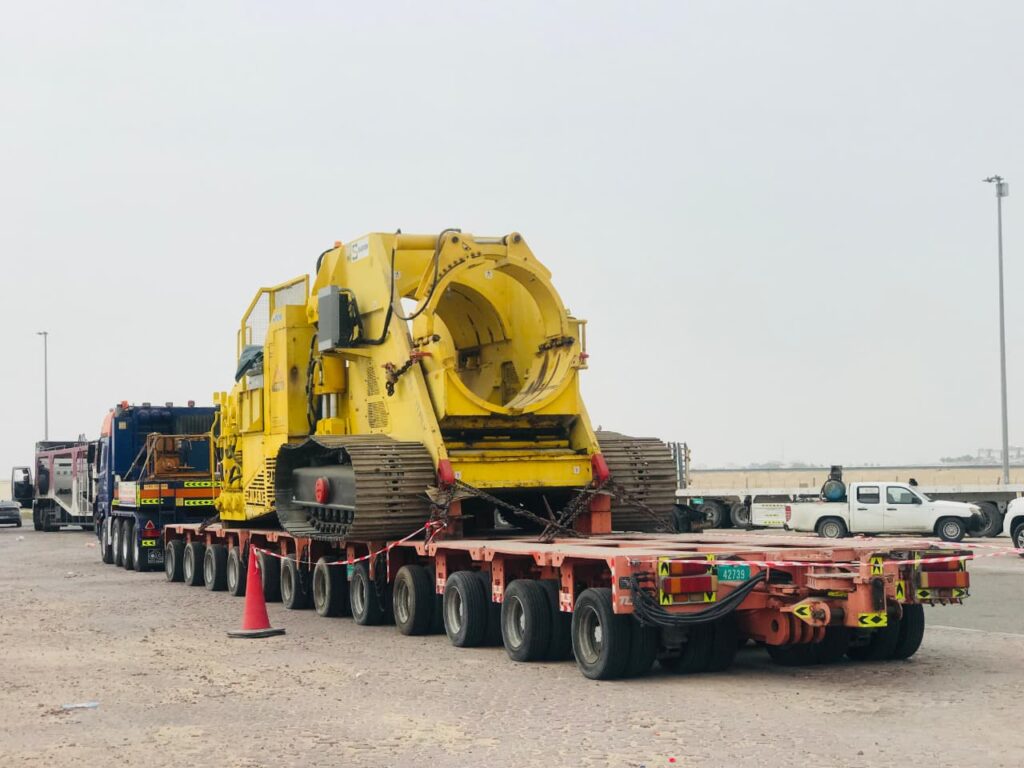
This project highlights the meticulous planning and execution required for long-haul, cross-border heavy lift logistics. Three Lines Shipping successfully transported a massive 110-Metric Ton Pipe Bending Machine from Hamriyah Freezone in Sharjah, UAE, all the way to Dammam in the Kingdom of Saudi Arabia, which is a rigorous 900-kilometer journey.
Handling a cargo of this scale across international borders and multiple emirates required strict regulatory compliance, professional escort deployments, and strategic road modifications.
Why does moving a 110-Ton Pipe Bending Machine demand logistics expertise?
Pipe bending machines are critical infrastructure assets. They are heavily utilized in the oil and gas, construction, and manufacturing sectors to fabricate pipelines and large curved components. Because industrial downtime is costly, the timely and secure transportation of these units is vital for maintaining production schedules in the GCC.
Transporting a 110-ton concentrated load with a 4-meter width and height over 900 kilometers requires advanced axle-load distribution to protect public highways and avoid transit delays at border crossings.
| Asset Type | Industry Role | Gross Weight | Transport Distance |
| Pipe Bending Machine | Oil & Gas / Pipeline Fabrication | 110 Metric Tons | 900 km (Cross-Border) |
Key Cargo Dimensions
Why does moving a 110-Ton Pipe Bending Machine demand logistics expertise?
A 4-meter width and height constitute Over-Dimensional Cargo (ODC) under both UAE and KSA traffic regulations. Because the machine exceeded standard highway lane limits, standard transit routing was not an option.
To guarantee safe passage through highly congested areas, we executed a complex, multi-emirate transit plan.
Key operational solutions that we provided:
- Strategic Road Openings in the UAE: Due to strict traffic regulations, we meticulously coordinated road openings and controlled transits across major arteries in three emirates:
- Sharjah: Navigated via Al Dhaid Road (E88).
- Dubai: Transitioned through the Dubai-Al Ain Road (E66) and Emirates Road (E611) to bypass urban congestion.
- Abu Dhabi: Secured passage via Sweihan Road (E20), Al Ain Road (E22), and the Sheikh Khalifa Bin Zayed Al Nahyan International Road (E11) leading toward the Saudi border.
- Cross-Border KSA Compliance: Moving ODC into Saudi Arabia requires precise documentation. We secured all necessary international heavy-lift permits prior to arrival at the border, preventing costly delays.
- Professional Escort Deployment: Throughout both the UAE and KSA legs of the journey, we deployed professional escort vehicles to manage civilian traffic, guide the trailer through tight clearances, and ensure the safety of the public and the cargo.
What key logistical challenges were overcome?
The success of a 900 km international heavy-lift project is measured by the seamless transition of the cargo through different regulatory jurisdictions without incident.
| Key Metric | Complexity of this Project | How Our Team Helped |
|---|---|---|
| Cross-Border Transit | 900 km UAE to KSA Journey | Managed all international customs and heavy-lift permitting proactively. |
| Regulatory Compliance | Strict UAE & KSA Traffic Laws | Coordinated multi-emirate road openings (E88, E611, E11) with local authorities. |
| Traffic Management | 4.0m Cargo Width | Deployed continuous professional escort services across two countries. |
| Supply Chain Continuity | Critical Oil & Gas Equipment | Delivered the 110-ton asset securely to maintain GCC production schedules. |
This project reinforces Three Lines Shipping’s robust capability in managing complex, long-haul logistics across the GCC. Our commitment to engineering excellence, regulatory foresight, and operational safety ensures that even the heaviest and most critical industrial equipment reaches its destination on time.