

Every year people move goods worth more than 100 billion dollars between these two places. But you need to be careful. The cost and time can change a lot based on what you pick. A large 40ft container on a ship might cost around $2,500. But if you try to fly that same cargo you could pay ten times that amount.
We wrote this guide to make things clear for you. We will check the prices and the schedules and the laws. Our goal is to help you decide wisely so you can stop worrying.
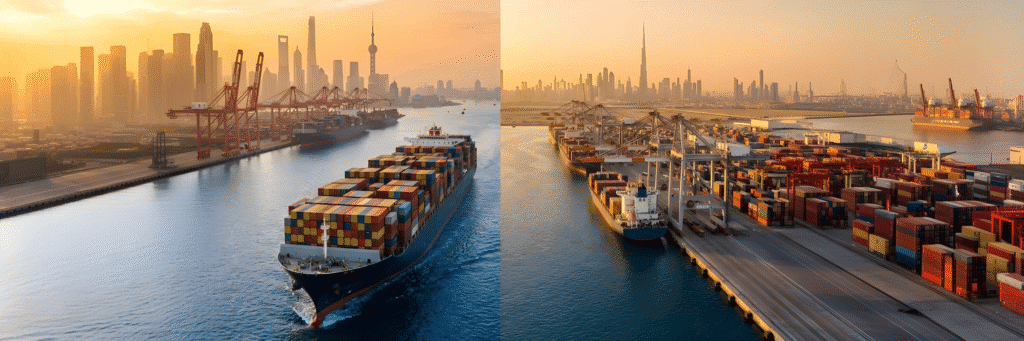
What are the main ways to move your goods
Shipping from China to the UAE generally takes between 2 to 7 days by air. If you go by sea it takes about 20 to 45 days. Air freight usually costs between $3 and $9 for every kilogram. Going by sea saves you the most money. You could pay just $100 to $200 if you share space or up to $5,000 for the whole box. You have four main ways to match your money with your schedule.
Sea freight
This is the wallet friendly choice for big shipments that are not in a hurry. Cargo ships travel from big Chinese ports like Shanghai and Shenzhen straight to Jebel Ali in Dubai. This is how most goods get to the UAE.
Air freight
Air freight gets your products there in days instead of weeks. The catch is the price tag. You will pay a lot more per kilogram than you would with a ship. If your items are worth a lot or you are in a rush then the speed justifies the cost.
Express courier
Big names like DHL or FedEx handle small packages and papers very well. This is the quickest way to get things done. It is perfect for lighter loads under 100 kg when time is more important than price.
Door to door delivery
This service feels like the easy way to manage logistics. A single company takes care of the whole job. They pick up the goods at your supplier in China and handle all the customs work. Then they deliver it right to your door in the UAE.
How does shipping by sea actually work
The process is pretty standard. You book space on a vessel and move your goods to the port. You clear customs in China and the ship sets sail. Once it arrives you clear customs in the UAE and get your delivery.
| Service Type | Best For | Typical Use Case |
| FCL | Large shipments | Great for big loads that fill a container |
| LCL | Smaller volumes | Good for small loads under 15 cubic meters |
| Reefer | Sensitive goods | Needed for food and medicine |
| Oversized | Big machines | Used for big machines and heavy gear |
How does air freight work
Air freight focuses entirely on speed. You get a spot on a plane and the cargo moves quickly through the airport. The flight itself only takes a few hours. The ground work is what takes up most of the time.
What determines the cost of shipping
Prices change based on the method you choose and the market conditions. You should understand how pricing works to plan your spending.
Key factors that change the price
- Size and weight: Bigger shipments often get a better deal.
- Mode: Sea saves cash while air saves time.
- Season: Prices go up just before big holidays.
- Terms: The deal you make with your supplier decides who pays.
- Duties: You figure these out when the goods arrive.
How long does the trip take
Which ports handle the cargo
The route between China and the UAE connects some of the busiest ports in the world.
Major Chinese ports
- Shanghai: The main spot for goods heading to the UAE.
- Shenzhen: Handles the busy factories in the south.
- Ningbo Zhoushan: Moves massive amounts of cargo near Shanghai.
- Guangzhou: Another vital gate in the south.
- Qingdao: The key hub for northern goods.
Major UAE ports
- Jebel Ali in Dubai: The top port in the Middle East.
- Khalifa Port in Abu Dhabi: A modern spot with lots of room.
- Fujairah Port: Sits on the east coast.
Key airports
The main airports in China are Shanghai, Guangzhou, and Shenzhen. In the UAE we use Dubai International, Al Maktoum International, and Abu Dhabi International.
How do you clear customs
You must submit papers to the customs authority and pay your duties. Getting ready early is the best way to avoid hold ups.
Required documents
- Commercial Invoice: Proves the real cost of the items.
- Packing List: Shows exactly what is inside every box.
- Bill of Lading: Acts as your receipt for the shipment.
- Certificate of Origin: Tells customs where the goods were made.
- Import Declaration: The form you need for entry.
The process
You hand in your papers and pay the taxes. Then you wait for cargo release. Working with an expert makes this go much smoother.
Prohibited goods
The UAE stops some items to keep people safe. You must get a permit for restricted things. You should always look at the rules before you ship.
What taxes will you pay
You generally pay customs duties and VAT on imports.
Calculating duty
First you find the code for your product. Most goods have a 5% duty rate. You figure this out based on the item price plus insurance and shipping costs.
VAT and other fees
The UAE charges a 5% tax on the total value. You might also pay extra fees if you are late picking things up.
Free zones
Places like JAFZA let you keep goods there without paying taxes immediately. You only pay when goods enter the UAE mainland. This works well for companies that send goods to other countries.
What about special cargo services
Some items need a gentle touch or special handling.
Heavy equipment
Huge machines require permits and a check of the road. We use special trucks for this job.
Hazardous cargo
Dangerous items require strict safety steps. You need the correct forms and safe packaging.
Customized solutions
Hard projects might need a mix of trucks and ships. Experts can build a plan for any problem you meet.
What happens after arrival
Keeping goods safe and delivering them are vital steps.
Warehousing
Bonded warehouses allow you to hold stock before paying tax. Non bonded places are for goods that are already cleared.
Inventory management
New systems watch your stock levels all the time. We can also pack orders for your online shop.
Regional distribution
The UAE is a hub for the whole Gulf. Goods cleared in Dubai can move easily by road to Saudi Arabia, Oman, Bahrain, Qatar, and Kuwait.
How to pick the right partner
A good partner makes the shipping process simple.
What to look for
- Coverage: Find offices in both China and the UAE.
- Certifications: Check for quality badges and membership in world groups.
- Service range: Ensure they can manage planes and ships.
- Experience: They must know your type of product.
Questions to ask
What does the price cover? Who takes care of customs? Can I see where my boxes are? What kind of protection do you have?
Why we are the right choice
Three Lines Shipping brings over two decades of experience to this route. We belong to trusted global networks and have offices across the UAE, Qatar, Saudi Arabia, Bahrain, and Oman.
We provide storage and heavy lifting and packing in one spot. We handle it all so you only talk to one person. Let us take care of the shipping so you can work on your business.