

In the shipping business, “consolidation” is the best way to save money if you cannot fill a whole truck or container. You share the space and you share the cost. But the way we do this changes a lot depending on if your goods are moving across town or across the ocean. This brings us to the big comparison between LTL (Less than Truckload) and LCL (Less than Container Load).
Both methods allow you to split the bill. But they work in very different worlds. Knowing the difference helps you plan better. This is even more important now that regulations in 2025 are getting stricter.
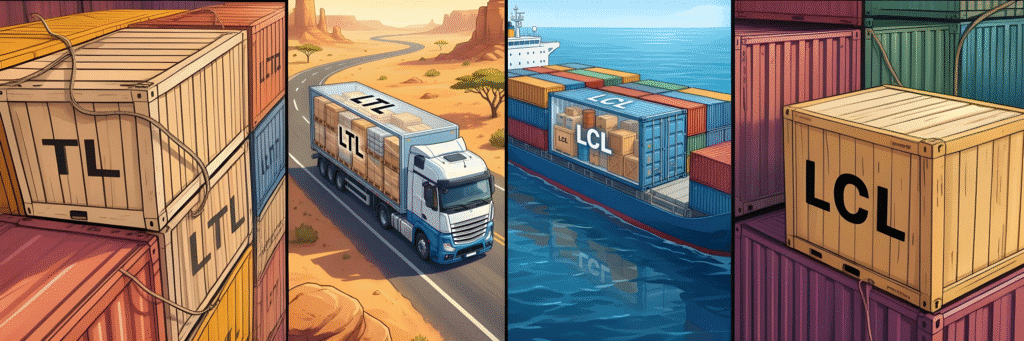
Where do these two methods operate
The biggest difference between them is simply where they go and what vehicle carries them.
- LTL (Less than Truckload) is the standard for moving things on land. It uses trucks and vans to travel on local roads. It is the main way we move goods between states or nearby cities.
- LCL (Less than Container Load) is the main way to move things on long trips. It uses big metal containers that travel on ships and trains.
In short, LTL keeps your goods on the road while LCL takes them across the water.
Balancing how fast you need it against the cost
When you choose between these two, you are usually deciding between saving time or saving money.
The speed of road transport
LTL is much faster. It can often save you up to two weeks compared to ocean freight. Trucks follow direct road networks so they avoid the long wait times at ports.
For businesses here in the GCC logistics sector, LTL is vital. The road network connecting the UAE, Saudi Arabia, and Oman is very good. Trucking goods from Dubai to Riyadh is fast and reliable.
The value of ocean transport
LCL is great for saving money on volume. LTL is cheaper than renting a whole truck but ocean freight is often cheaper per item. Ships carry huge amounts of cargo which drives the price down.
It is also interesting that LCL often has more space available during busy seasons. From August to October, it can be a smart backup plan for global importers when full containers are hard to find.
The risks of sharing space with others
The journey your cargo takes is different for each mode and so are the risks.
The risk of one bad shipment
LCL involves many steps. Your goods go from a pickup to a warehouse and then into a shared container.
There is a risk here we call “contagion.” Your cargo shares a container with other people. If just one person makes a mistake with their paperwork or packs something banned, customs will hold up the entire container. This means everyone waits because of one mistake.
Tracking your goods on the move
LTL shipments usually offer better tracking. The cargo is on a truck that stays within cell phone range. You can see exactly where it is. This is harder to do with ocean freight once the ship leaves the port.
What changed in the rules for 2025
We are seeing some big shifts in regulations and pricing that will affect your wallet this year.
Changes for road transport
Carriers are getting tough on how dense your cargo is. This is a big deal if you are moving heavy things like batteries. If you get the classification wrong you might get hit with a surprise bill.
You also need to watch your expenses. Extra charges for diesel fuel have climbed to about 25%. On the bright side there are new rewards for sharing truck space which helps cut down on pollution.
Changes for ocean transport
Everyone is focusing on the environment now. Sending goods to Europe comes with a new set of hurdles. You must have specific eco labels for items like clothes and electronics. Without the right tags your shipment might get turned away at the border.
How to choose what works for you
It all comes down to where you are going and when you need to be there. For local businesses in the Gulf using trucks is often the fastest way to move goods across borders. But for shipping around the world sharing a container is still the best way to save cash. You just need to double check your documents.We know the ins and outs of both local trucking and global shipping at Three Lines Shipping. We are ready to help you navigate the new road rules for Saudi Arabia or sort out your paperwork for Europe. Our goal is to keep your supply chain moving without breaking the bank.